
The Communicative Nature of Art in Ancient and Contemporary Contexts
- Authors
-
-
Dr. Sanchihar Manisha
Author
-
- Keywords:
- Education, Social Values, Art, Culture, Communication, Cultural Preservation, Social Transformation, Knowledge Centres, Vasudhaiva Kutumbakam
- Abstract
-
This paper explores the historical role of education in India, highlighting its focus on character formation and social values, rather than just technical skills. Rooted in the philosophy of "Vasudhaiva Kutumbakam" (the world is one family), education aimed to uplift the community. Art and literature were central to this vision, serving as powerful mediums for transmitting cultural values across generations through oral traditions, performances, and visual and written expressions.
In ancient India, art education was practice-based, with students learning technical skills and symbolic meanings in "Chitrashalas." This rigorous training fostered discipline and precision, essential for artistic and personal development. Art was understood as a universal mode of communication, encompassing all forms of knowledge, as articulated in Bharata's Natyashastra.
Art also played a crucial role in structuring society, with artistic professions often linked to hereditary roles, though individual creativity was also valued. Thinkers like Chanakya integrated art and vocation into governance, promoting social cohesion. Furthermore, art education was vital for cultural preservation, acting as a record of mythological narratives and historical events, as seen in the Ajanta murals. Oral traditions, combined with visual and performative art, created a layered system for transmitting India's cultural heritage.
Education, religion, and art were intertwined, with art serving as an effective medium for religious and moral teachings in temples and other institutions. Knowledge centers like Takshashila and Nalanda were interdisciplinary hubs that fostered cultural exchange and spread Indian artistic traditions globally.
However, the integration of art and crafts declined by the 8th and 9th centuries CE, leading to a marginalization of art. In the contemporary period, education's narrow focus on employability has further sidelined art. The paper argues for revisiting the ancient model of art as communication to restore its role in fostering empathy, dialogue, and social responsibility, addressing modern challenges, and preserving cultural continuity. Reclaiming art's communicative function can help realize the spirit of "Vasudhaiva Kutumbakam," uniting the world through shared values and culture.
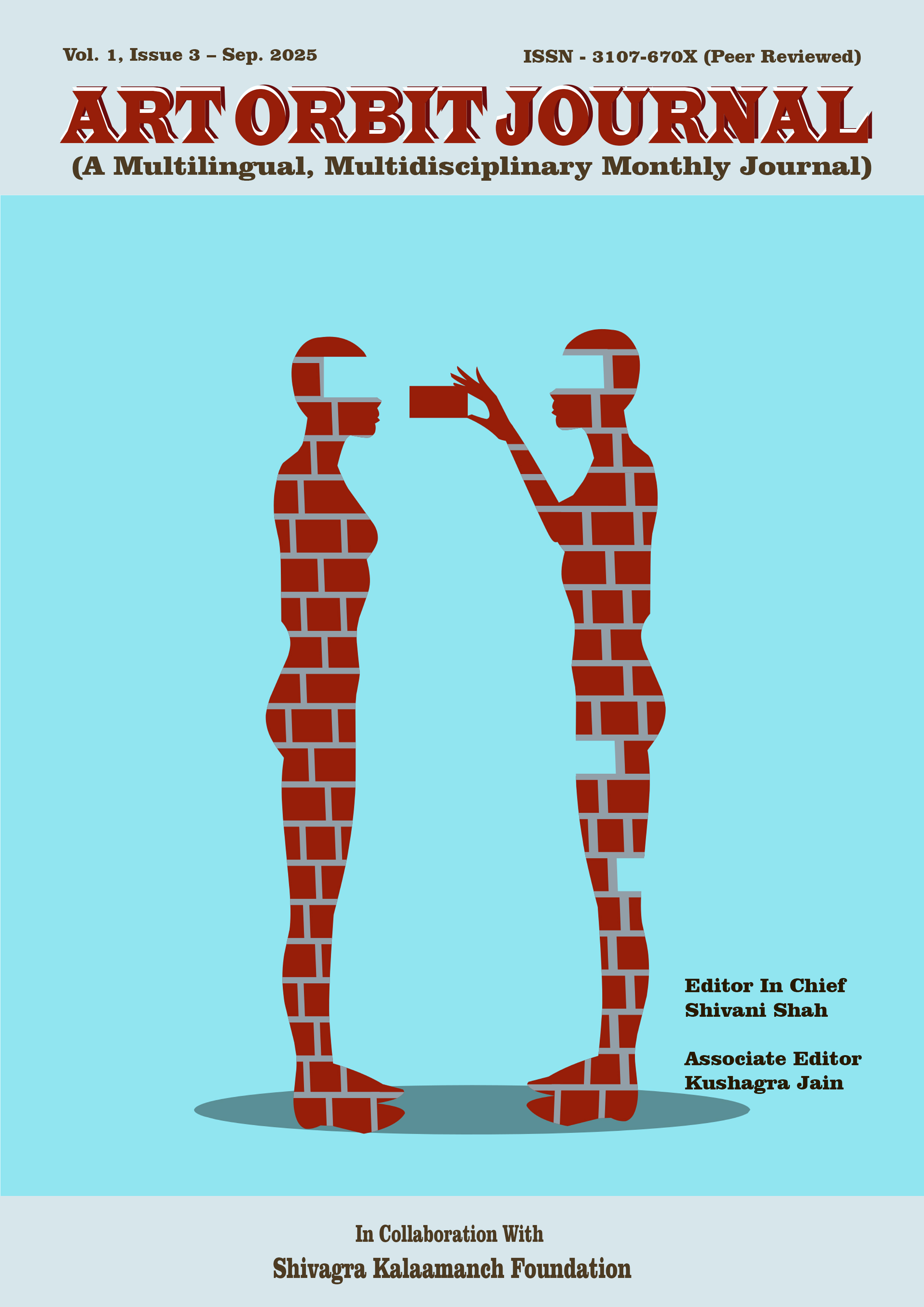
- Cover Image
-
- Published
- 2025-09-30
- Section
- Articles
- License
-
Copyright (c) 2025 ART ORBIT

This work is licensed under a Creative Commons Attribution-NonCommercial-NoDerivatives 4.0 International License.
